
FISH · ENDANGERED
Whale sharkRhincodon typus
The whale shark is enormous but feeds on plankton, small fish and eggs. Read individual spot patterns, feeding direction and whether boats alter its movement; touching is never part of the encounter.
- Common name
- Whale shark
- Scientific name
- Rhincodon typus
- Catalog status
- Endangered
- Activity
- Filter-feeds by day
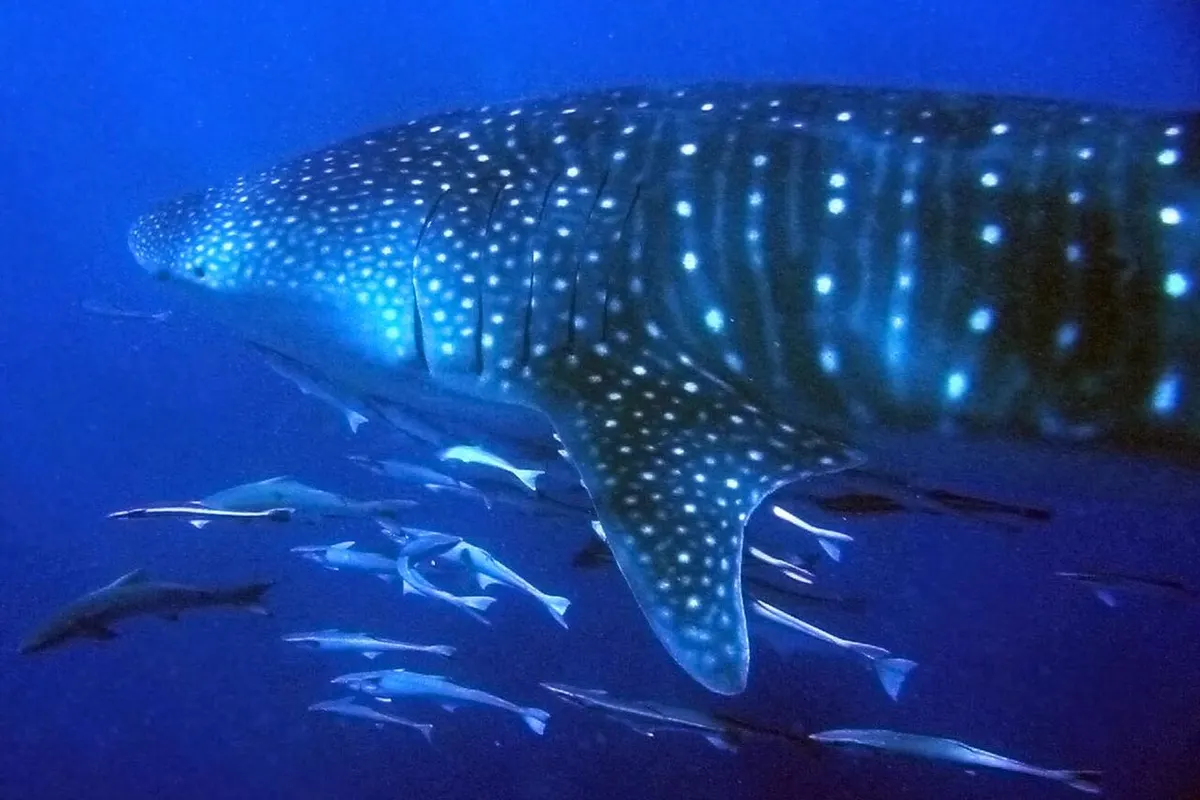
Broad flat head, terminal mouth, pale spots and bars, and strong side ridges
A distant fin cannot confirm a whale shark; combine body scale, tail movement and dorsal pattern.
About Whale shark
The whale shark is the largest living fish and a filter-feeding shark that takes plankton, small fish and fish eggs. It occurs in tropical and warm temperate seas. Seasonal gatherings form in productive water, but arrival and length of stay change with food and sea conditions.
Identification
The head is broad and flat, with the mouth close to the front of the snout. Pale spots and bars cover a dark back, and strong ridges run along the sides. The spot pattern can identify an individual. Boats still need to keep the required distance from this very large fish.
Habitat
Whale sharks use coastal water, the open ocean and lagoons around coral atolls. They also move across ocean basins. Upwelling, fish spawning and coral reproduction can create short pulses of food that draw animals together. Because these feeding events depend on local productivity, a named whale-shark season describes probability rather than an appointment. Water temperature alone cannot guarantee a gathering. Travellers should check current sightings, permit rules, operator briefings and temporary closures, and accept that a responsible trip may remain boat-based or finish without an in-water encounter. Choosing a longer window can reduce pressure to chase a single animal.
How to find evidence in the field
Read evidence that does not need to approach you, then decide whether to remain in place.
Slow surface feeding
Open-mouth travel or feeding in a patch requires boats and swimmers to remain to the side and behind.
Individual spots
Patterns behind the gills support photo identification but never override distance rules.
Birds and spawning events
Productivity pulses can gather sharks without occurring on a fixed date.
Turn, dive or acceleration
These are signals to stop following, not reasons to pursue.
From diet to life history
Where energy comes from
Filter-feeds on plankton, fish eggs and small schooling organisms, with gatherings tied to productivity pulses.
How it passes through life
Slow growth, late maturity and large-scale movement mean a gathering site is only one window in a long life cycle.
What it changes
Connects plankton pulses with a very large pelagic consumer and helps reveal productive ocean areas.
A whale shark swims with its mouth open or draws in water where food is dense, then filters prey at the gills. It can feed slowly at the surface and dive into deep water. Vessel strikes, bycatch and poorly managed tourism can injure animals or change their behaviour.
Why conservation matters
International trade in whale sharks is regulated. Conservation work seeks to reduce bycatch, vessel strikes and repeated disturbance at gathering sites. Photo identification, satellite tags and public sighting reports help research movement, while every swim remains subject to local permits.
Animal observation boundaries
- Choose a licensed operator that explains limits on swimmers, boat speed and distance. Accept cancellation when conditions are unsuitable.
- Swim parallel and to the side. Do not touch, hold a fin, dive underneath or block the direction of travel.
- Stop following if the shark turns, dives or accelerates, and do not let several boats surround one animal.
Sources
These sources support the identification, habitat and observation guidance on this page. Conservation assessments and local population conditions can change, so current management advice still takes priority in the field.
- NOAA Fisheries · Whale shark identification
- NOAA Fisheries · Shark conservation
- GBIF · Rhincodon typus
- IUCN Red List · Rhincodon typus
Page updated . To report an error, send the page URL and a verifiable source through the contact page.