
MAMMAL · VULNERABLE
Snow leopardPanthera uncia
Snow leopards occur at low density over large ranges. Skilled observation means reading scrapes, scent sites, droppings, prey alarm and terrain from the opposite slope, not following tracks toward a cat.
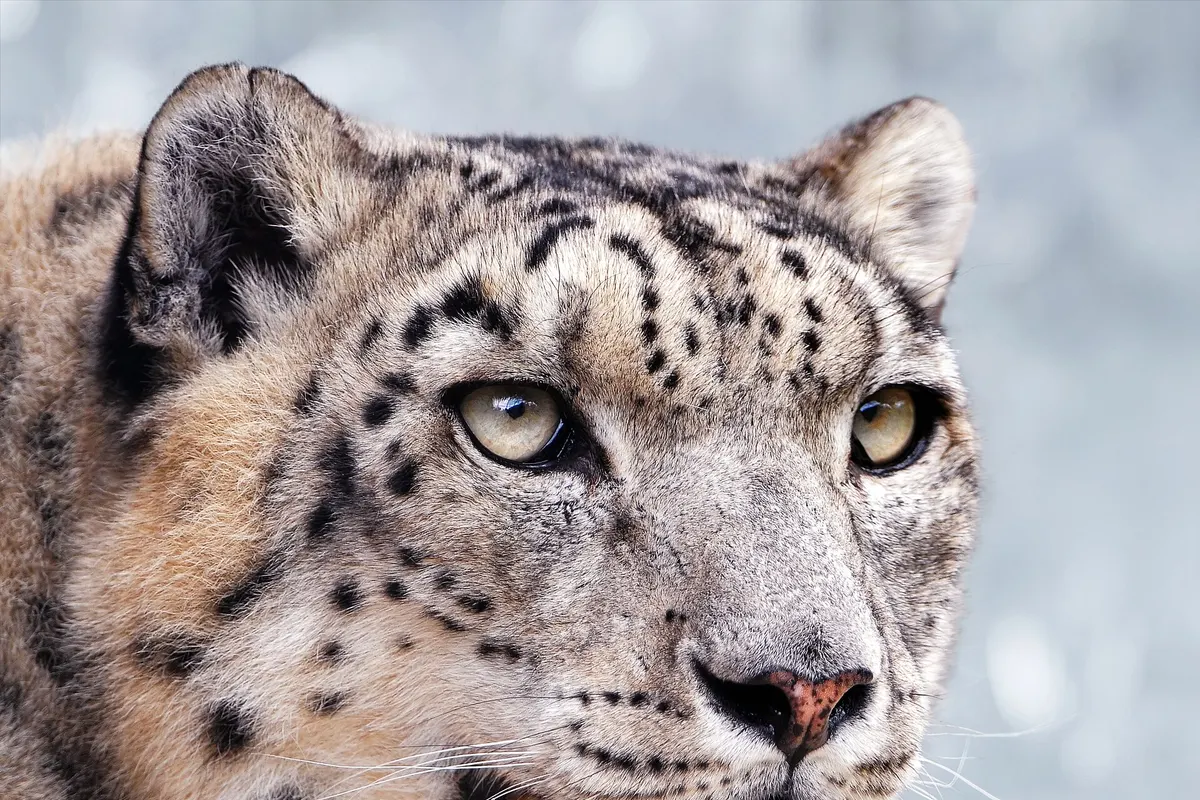
- Common name
- Snow leopard
- Scientific name
- Panthera uncia
- Catalog status
- Vulnerable
- Activity
- Dawn and dusk
Repeated scrapes and scent marks on ridges, gully mouths and cliff bases
Canid tracks often show claws and a more oval outline, but melting enlarges prints; pad shape and trail pattern must be read together.
About Snow leopard
Snow leopards occupy cliffs, valleys and alpine grassland across the mountains of Central Asia and the Tibetan Plateau. They occur at low density and range widely, so direct sightings are rare. Tracks, scrapes, scent marks, droppings, prey response and camera traps provide much of the field evidence.
Identification
Dark rosettes lie across a pale grey coat with long dense fur. Broad paws help on snow and loose rock. The long thick tail provides balance on steep ground and can wrap around the body at rest. Compared with a common leopard, the snow leopard is paler, more heavily furred and has a proportionally longer tail.
Habitat
The species uses a patchwork of bare rock, steep slopes, gullies and alpine pasture. Wild sheep and goats are important prey. When prey moves lower in winter, a snow leopard may also enter lower valleys and come closer to livestock areas.
How to find evidence in the field
Read evidence that does not need to approach you, then decide whether to remain in place.
Scrapes
Often placed at terrain bottlenecks or conspicuous communication sites; record habitat type, not coordinates.
Scent and rubbing
Prominent rock can be marked repeatedly; do not approach to smell or sample.
Broad tracks
Use stride and trail on snow or mud, without following fresh prints.
Prey vigilance
Ungulates staring together may indicate a predator, a person or another threat.
From diet to life history
Where energy comes from
Mountain ungulates such as blue sheep and ibex are major prey, with smaller animals also taken; prey loss can increase livestock conflict.
How it passes through life
Mostly solitary cats communicate asynchronously at repeated terrain features; breeding and female-with-cub periods are especially sensitive.
What it changes
As a mountain predator, the species links wild ungulates, pastoral management and ecosystem integrity.
Most adults travel alone. They leave scrapes, urine and droppings at repeated terrain features. Ridges, the base of cliffs and gullies provide travel lines and cover for an approach to prey. Livestock losses can intensify conflict where wild prey is scarce or herds enter cat habitat.
Why conservation matters
Snow leopard conservation includes wild prey, pasture management, illegal trade and household income. Predator-proof corrals, livestock insurance and community monitoring can reduce retaliatory killing. Population estimates remain difficult, and public coordinates or close pursuit add avoidable risk.
Where to understand it
These destinations connect Snow leopard with a wider habitat. A relationship in the catalog never guarantees a sighting.
Animal observation boundaries
- Use binoculars or a scope from the opposite slope. Do not close the distance by following fresh tracks.
- If a cat is resting, feeding or near prey, hold one position and do not form a ring around it.
- Do not publish current locations, dens, cubs or camera-trap coordinates, and never promise a fixed sighting.
Sources
These sources support the identification, habitat and observation guidance on this page. Conservation assessments and local population conditions can change, so current management advice still takes priority in the field.
- IUCN Save Our Species · Central Asia
- GBIF · Panthera uncia
- IUCN Red List · Panthera uncia
- IUCN · Action for snow leopards
Page updated . To report an error, send the page URL and a verifiable source through the contact page.