
PLANT · VULNERABLE
Dove treeDavidia involucrata
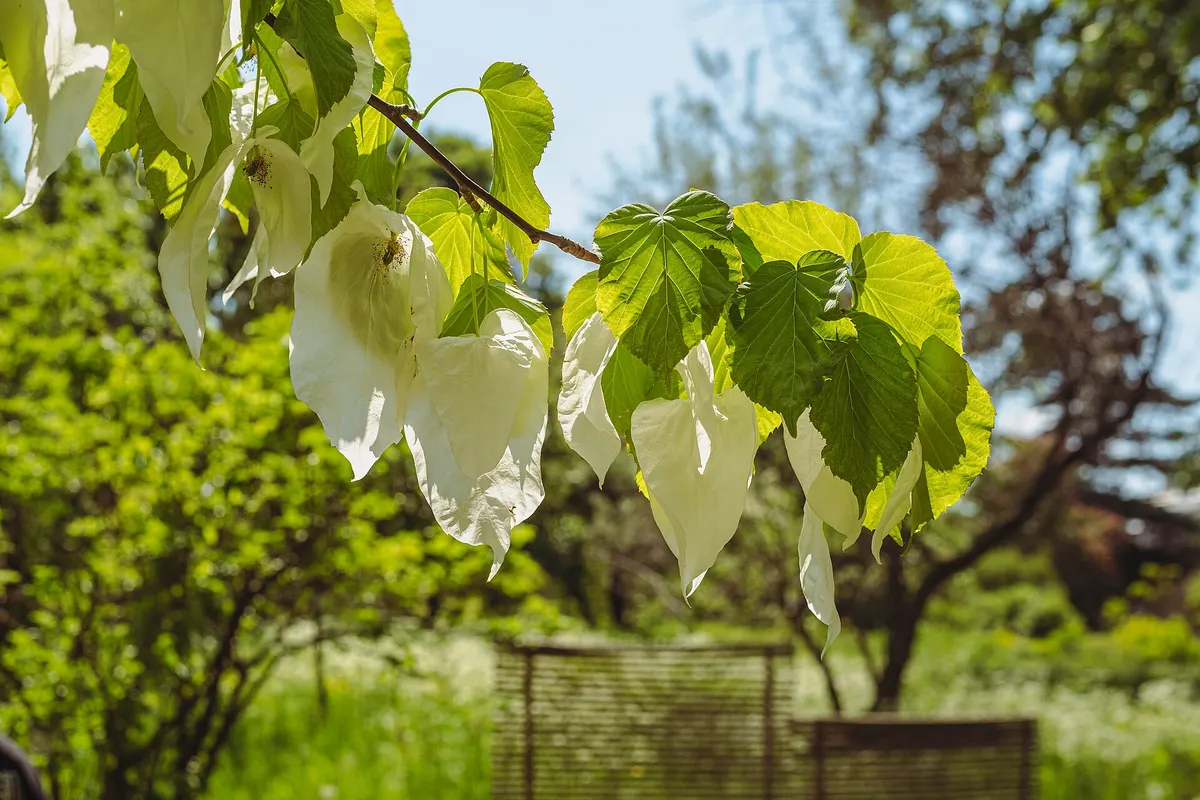
The true flowers are small. The famous white 「doves」 are two unequal bracts around the flower head. Outside flowering, use heart-shaped leaves, bark, fruit and montane mixed-forest context.
- Common name
- Dove tree
- Scientific name
- Davidia involucrata
- Catalog status
- Vulnerable
- Phenology
- Flowers Apr-May
Two unequal hanging white bracts around a compact rounded flower head
White bracts are conspicuous in gardens, but a wild record also needs leaves, fruit and native south-central Chinese montane-forest context.
What kind of plant is Dove tree
The dove tree is a deciduous tree native to montane forests in south-central China. Its familiar common name comes from two hanging white bracts that move around the flower head in spring. The true flowers are small and clustered at the centre, so the white structures should not be described as petals.
Identify leaves, flowers, fruit and bark
During flowering, look for two unequal white bracts around a compact rounded flower head. Outside that short season, combine broad heart-shaped leaves with pointed tips, mature bark that can flake in plates, and the hard oval fruit. A planted tree outside China may be correctly identified but does not represent a wild population.
Where it grows
Wild dove trees occur in moist mountain forest, often within mixed woodland where canopy, slope, soil and stream moisture create a cool local climate. Flowering time changes with elevation, aspect and spring temperature, so a calendar date from a garden cannot predict every wild site.
How to find evidence in the field
Read evidence that does not need to approach you, then decide whether to remain in place.
White bracts
They move in late-spring wind and one is usually larger; do not call them petals.
Heart-shaped leaves
Check the broad heart-shaped base and pointed tip with twig arrangement.
Hard fruit
Green fruit darkens as it ripens; fallen fruit remains in place.
Flaking bark
Mature bark can lift in plates and should be combined with leaf and fruit evidence.
From form to phenology
How it occupies space
A deciduous tree that can reach about 20 m; Davidia involucrata is the sole accepted species in its genus.
When it changes
White bracts appear in late spring and hard fruit develops toward autumn, with timing shifted by elevation, aspect and year.
How the next generation moves
Small flowers form one head and develop into a hard multi-seeded fruit; germination is irregular and young trees can take years to flower.
The canopy and leaf litter contribute to forest structure, while flowers and fruit become seasonal resources within the woodland community. Seedlings depend on suitable forest conditions over many years; one mature flowering tree does not by itself show that a population is regenerating.
Why conservation matters
Protecting the species means retaining native forest, mature trees and younger age classes rather than collecting seed from a photogenic individual. Garden cultivation can support awareness and ex situ collections, but it does not replace connected habitat or monitoring of wild populations.
Plant observation boundaries
- Stay on established paths and photograph the whole tree, leaves and bracts without stepping into the root zone.
- Do not collect fallen or attached flowers, fruit, seeds, bark or seedlings from a wild population.
- Avoid publishing precise locations of small wild stands where collection or trampling could become a risk.
Sources
These sources support the identification, habitat and observation guidance on this page. Conservation assessments and local population conditions can change, so current management advice still takes priority in the field.
- GBIF · Davidia involucrata
- Kew Plants of the World Online · Davidia involucrata
- Kew Plants of the World Online · Davidia involucrata
Page updated . To report an error, send the page URL and a verifiable source through the contact page.